Why Recurring Revenue Beats One-Time Client Work | TranscendOps
Executive Summary
Imagine closing a $15,000 project, celebrating the wire transfer, only to stare at an empty pipeline three weeks later. This feast-or-famine rhythm defines the one-time project model for agencies, consultants, and service businesses—a cycle of relentless hunting for the next deal. Now contrast that with the quiet compounding of recurring revenue: steady deposits, predictable forecasting, and a business that scales without your constant grind.
In this analysis, we dissect recurring revenue vs one-time projects, revealing why the subscription business model delivers sustainable revenue. For agency owners, the shift to Monthly Recurring Revenue (MRR) isn't just a tactic; it's a structural upgrade. We'll explore the compounding effects, local business preferences for ongoing commitments, and how autonomous service delivery unlocks true scalability. Backed by the real math, this model transforms volatile income streams into a fortress of financial stability.
By the end, you'll see why high-caliber service providers are ditching project-based work for MRR systems that reward retention over acquisition.
The Feast-or-Famine Trap of One-Time Projects
Service business owners know the drill. You land a marquee client for a website redesign or marketing campaign overhaul. Months of late nights culminate in a hefty invoice. Relief washes over as funds hit the account. But then? Silence. Proposals languish, leads dry up, and payroll looms. This is the inherent volatility of one-time projects—a model where revenue spikes like a summer storm, then evaporates.
Consider the operational toll. Each project demands a full sales cycle: discovery calls, scoping, proposals, negotiations, delivery, and handoff. Your team's capacity ties directly to billable hours, creating a linear ceiling on growth. Scale means hiring more bodies, but without recurring commitments, utilization gaps widen. Burnout creeps in as you chase the next feast to fend off famine.
Financially, it's a nightmare for forecasting. Banks scrutinize inconsistent cash flow when you seek loans or lines of credit. Valuation multiples suffer; investors prefer predictable streams over lumpy earnings. In recurring revenue vs one-time projects, the latter forces reactive pricing—discounts to close deals, scope creep to fill gaps, eroding margins.
Agencies trapped here often mask the pain with side hustles or personal savings bridges. But sustainability demands evolution. Enter the subscription business model, where clients pay monthly for ongoing value, flipping the script from transactional to relational.
The Compounding Power of Recurring Revenue
From Linear Growth to Exponential Stability
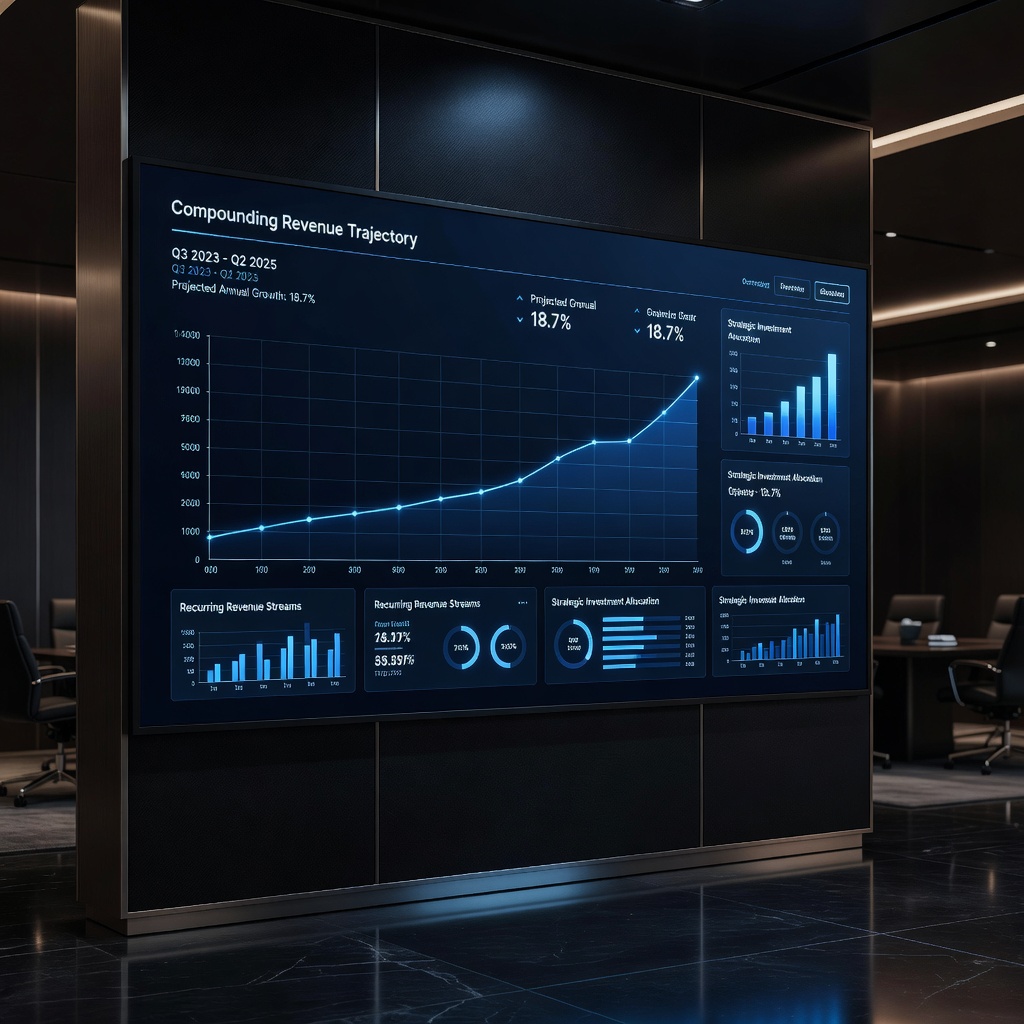
Recurring revenue operates like a flywheel. Initial acquisition costs amortize over time as clients renew. Each month, MRR compounds: base retainers plus upsells, referrals, and expansions. Unlike one-time projects, where revenue plateaus post-delivery, sustainable revenue builds equity in relationships.
Picture a marketing agency shifting to tiered subscriptions: $2,000/month for core SEO and content, $5,000 for full-funnel management. Year one: acquire 10 clients, hit $240,000 MRR. Year two: 90% retention yields $216,000 baseline, plus five net new clients and 20% expansions—pushing past $350,000 without proportional sales effort.
Lifetime Value Unlocked
Customer Lifetime Value (LTV) skyrockets. One-time LTV caps at project value; recurring LTV multiplies by average tenure. With churn under control, this metric funds bolder investments—team expansion, tech stacks, even acquisitions.
Compounding extends to valuation. SaaS-like multiples (4-10x ARR) apply to service MRR, dwarfing the 1-2x for project firms. Exit liquidity beckons for founders eyeing freedom.
Recurring models turn clients into assets, not expenses—each renewal a deposit in your business's compounding account.
Why Local Businesses Crave Subscription Models
Local service providers—dentists, gyms, salons—have long embraced subscriptions: memberships, maintenance plans, VIP retainers. Why? Predictability aligns with their world. Fixed monthly marketing budgets beat sporadic campaigns. They seek partners who optimize continuously, not set-it-and-forget-it.
Agencies serving SMBs tap this vein. A local restaurant prefers $1,500/month for social media, email nurturing, and review management over a $10,000 one-off rebrand that gathers dust. Subscriptions embed you as indispensable, fostering loyalty through results.
- Budget certainty: Aligns with their cash flow cycles.
- Ongoing ROI: Measurable monthly gains over sunk costs.
- Relationship depth: Evolves from vendor to strategist.
- Lower risk: Exit clauses protect both sides.
This preference scales nationally. Consultants offering compliance audits or HR support find takers in retainer formats. The subscription business model bridges the gap between project allure and long-term partnership.
Autonomous Service Delivery: Scaling Without the Grind
The Infrastructure Shift
Recurring revenue demands autonomous service delivery to avoid trading hours for dollars. Manual fulfillment caps at your bandwidth; automation liberates.
Build systems: templated workflows, AI-driven content, self-serve dashboards. An SEO agency deploys rank trackers, automated reports, and evergreen optimizers. Clients log value 24/7, you oversee strategically.
Leverage for MRR Agencies
Core pillars:
- Standardization: Productize offerings into tiers.
- Tech stack: Tools like Zapier, Client portals, analytics suites.
- Delegation: Train juniors on SOPs; you focus on high-leverage.
- Feedback loops: Automated NPS, churn prediction.
Result? Serve 50 clients with a lean team, where one-time models choke at 10. MRR for agencies thrives on this autonomy, turning service into a scalable product.
To build these systems strategically, explore our recurring income systems guide.
The Real Math: Recurring Revenue vs One-Time Projects
Numbers don't lie. Let's model a mid-sized agency: 20% acquisition cost, 10% churn for recurring, 100% "churn" post-project.
Year-One Projections
- One-Time: 12 projects @ $12,500 avg = $150,000. Acquisition: $30,000. Net: $120,000. Month 13? Zero baseline.
- Recurring: 12 clients @ $1,500 MRR = $216,000 ARR. Acquisition: $43,200. Net: $172,800. Plus compounding.
Three-Year Horizon
One-time requires 36 projects for $450,000 cumulative (net $360,000), endless sales grind.
Recurring: Year 1 $216k ARR → Year 2 $233k (retention +5 new) → Year 3 $290k. Cumulative net exceeds $650k, half the acquisition effort.
LTV math: One-time $12,500. Recurring (24mo avg): $36,000. Margins expand as delivery automates (60% vs 40%).
Sustainable revenue isn't about bigger projects—it's about deeper, repeating ones.
Implementing MRR for Agencies: Your Strategic Roadmap
Transition deliberately. Audit services for recurring fit: ongoing vs finite. Tier pricing: Essential, Growth, Enterprise. Pilot with loyal clients, iterate on delivery.
Metrics to track: MRR growth, churn rate, LTV:CAC ratio (aim 3:1). Nurture with value ladders—free audits to paid retainers.
Challenges? Scope fatigue. Counter with clear contracts, automated guardrails. The payoff: a business that runs on autopilot, rewarding your foresight.
Frequently Asked Questions
How does recurring revenue work for service businesses?
Service businesses productize expertise into monthly retainers. Clients subscribe for continuous delivery—SEO monitoring, content calendars, compliance checks—via standardized, scalable systems. Value accrues predictably, fostering long-term ties over one-offs.
What's the retention rate for recurring clients?
Retention in well-structured recurring models typically ranges from 80-95% annually, far surpassing one-time project repeat rates. Success hinges on consistent delivery and results tracking.
Can I set my own pricing?
Absolutely. Tailor tiers to value provided, market rates, and client segments. Start with cost-plus (delivery + margin), evolve to value-based as data accumulates. Flexibility defines the model.
Toward Sustainable Growth
Recurring revenue doesn't promise overnight riches— it forges enduring prosperity. For agencies weary of the project treadmill, MRR for agencies offers the architecture for autonomous service delivery and lasting wealth.
Toward understanding the recurring model in depth—and building yours—start with our comprehensive recurring income systems resource. The shift awaits those ready to plant roots, not chase shadows.