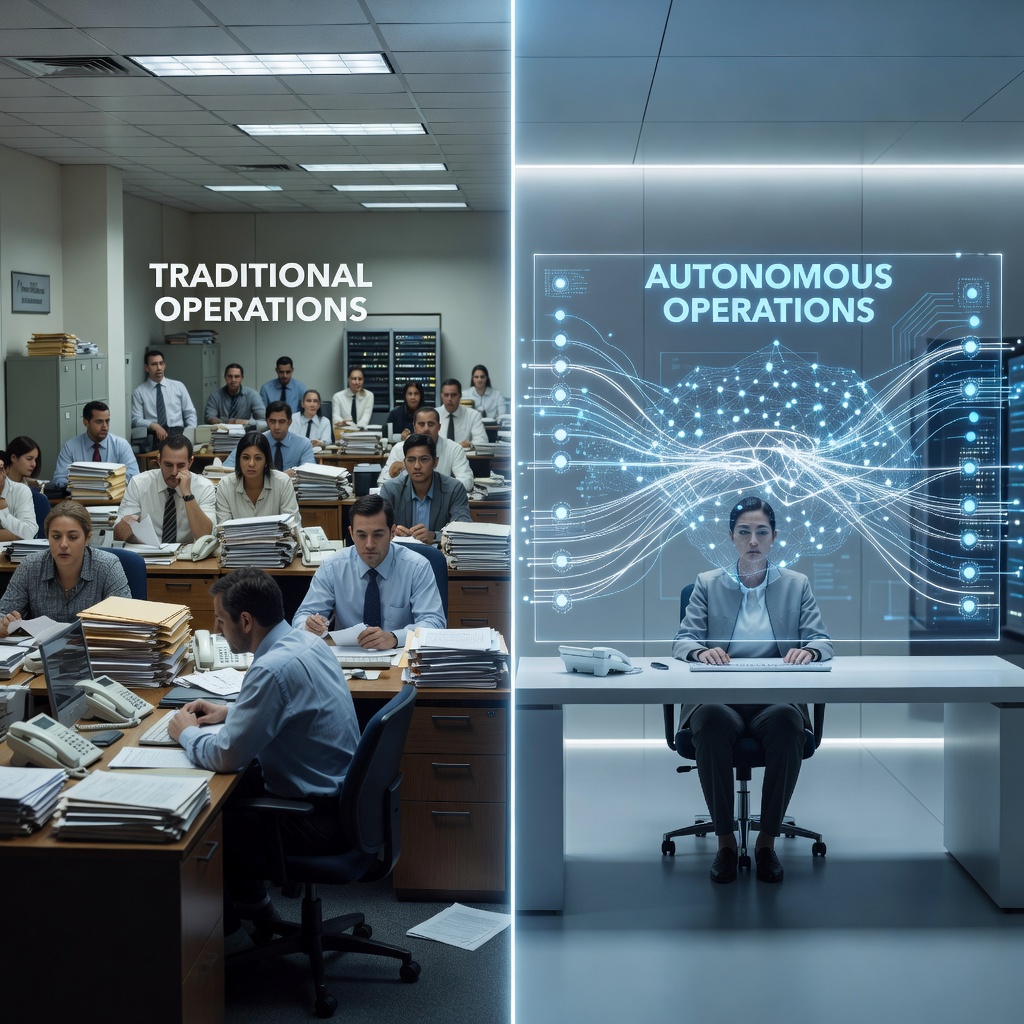
Autonomous Agency Operations vs Traditional Agency Model: Speed, Cost, and Scalability Showdown
At the Crossroads of Agency Management
Picture this: a high-stakes client pitch clock ticking down, and your agency needs to spin up a full-scale digital marketing campaign overnight. In the traditional agency model, you're scrambling to align freelancers, brief your team, and pray the stars align without last-minute no-shows. Now imagine flipping a switch—leveraging pre-built autonomous agency operations that deliver polished deliverables in hours, not weeks. This is the crossroads where agency owners stand today: cling to the familiar churn of human-powered teams or embrace the precision of infrastructure-driven autonomy?
The digital marketing landscape is ruthless. Clients demand lightning-fast results, razor-thin margins, and flawless execution at scale. Yet most agencies still operate under the traditional agency model—a relic of hiring talent, managing payroll, and firefighting turnover. Enter autonomous operations: a systems-first approach where proprietary infrastructure handles the heavy lifting. At AscendsOp, we don't just talk theory; we provide the backbone for this shift, unlocking agency infrastructure advantages that redefine what's possible.
This showdown isn't about one-size-fits-all. Both models have merits, but the tradeoffs in speed, cost, and scalability are stark. Let's break it down, layer by layer, to see which path leads to sustainable growth.
Head-to-Head: Fulfillment Speed, Operational Cost, Reliability, and Scalability Ceiling
Fulfillment Speed: Hours vs. Weeks
In the traditional agency model, speed is a bottleneck. Securing a new client means posting job ads, interviewing, onboarding—often 4-6 weeks before your first deliverable ships. Revisions? Cue the email chains and scheduling nightmares. Autonomous agency operations shatter this. With plug-and-play workflows powered by integrated tools for ad management, content generation, and analytics, fulfillment drops to days or even hours. A client brief enters the system, AI-augmented processes kick in, and boom—live campaigns with human oversight only where it counts.
Operational Cost: Fixed Overheads vs. Variable Efficiency
Traditional setups bleed cash on salaries (think $80K+ per full-timer), benefits, office space, and software licenses per user. Scale up? Double the payroll. Autonomous operations flip the script: a flat infrastructure subscription covers unlimited capacity. No idle desks during lulls; costs scale with revenue. Owners report 40-60% lower overheads, freeing capital for client acquisition. The tradeoff? Upfront learning curve to master the ecosystem—but once tuned, it's a cost-killing machine.
Reliability: Human Variability vs. System Consistency
Humans falter—sick days, burnout, key departures mid-project. The traditional agency model thrives on star performers but crumbles without them. Autonomous agency operations embed reliability in code: standardized SOPs, automated quality checks, and dashboards that flag issues in real-time. Reliability hits 99% uptime, with humans as strategists, not executors.
Scalability Ceiling: Headcount Limits vs. Infinite Infrastructure
Hiring caps traditional growth at your recruitment speed—maybe 20-50% YoY if lucky. Agency infrastructure advantages remove the ceiling: onboard 100 clients tomorrow, and the system absorbs it. AscendsOp's platform exemplifies this, handling spikes without proportional costs.
Client Experience: Consistency Through Systems vs. Human Variability
Clients don't hire agencies for drama; they want results that stick. The traditional agency model delivers variability—brilliant one quarter, sloppy the next due to team flux. Autonomous operations guarantee sameness: templated excellence, predictable timelines, and data-backed optimizations. Imagine a client portal where they track every pixel of progress, no PM hand-holding required.
Tradeoff acknowledged: bespoke creativity might feel rarer without a full creative roster. Yet hybrid models—AscendsOp's sweet spot—layer human ingenuity atop unbreakable systems, yielding superior retention. Clients stay longer, refer more, because trust compounds through consistency.
Owner Quality of Life: Managing People vs. Managing an Ecosystem
Agency ownership under the traditional agency model is a grind: performance reviews, conflict mediation, endless recruiting. Weekends vanish into Slack pings. Autonomous agency operations reclaim your time—manage dashboards, not drama. Owners shift to high-leverage work: sales calls, strategy, vision-casting.
The ecosystem demands vigilance—tweaking automations, updating playbooks—but it's proactive, not reactive. Many report 20-30 hour workweeks post-transition, with vacations that actually refresh. Freedom isn't hype; it's the reward of infrastructure mastery.
The Structural Advantage: Why Infrastructure-Based Operations Are the Future
Agency infrastructure advantages aren't a fad; they're evolution. As AI and no-code tools mature, autonomous operations outpace human limits. Traditional models persist for ultra-niche work, but for 80% of digital marketing—campaigns, SEO, social—systems win. AscendsOp equips you with this edge: scalable fulfillment without the baggage.
Dive deeper into this shift in our piece on The Rise of Infrastructure-Based Agencies. The future favors operators who build moats of efficiency, not empires of employees.
FAQ: Autonomous Agency Operations Unpacked
Are traditional agencies becoming obsolete?
Not obsolete, but evolving. The traditional agency model suits hyper-custom, relationship-heavy niches. Most will hybridize with autonomous operations for survival.
What is the main cost difference between traditional and autonomous models?
Traditional: high fixed costs (salaries, overheads) averaging 60-70% of revenue. Autonomous agency operations: 20-40% via subscription infrastructure, with costs scaling to output.
Can an autonomous operation handle custom, high-ticket client work?
Absolutely. Agency infrastructure advantages include modular customization—tailor workflows for premium clients while keeping speed and reliability intact. Human touch adds the polish.