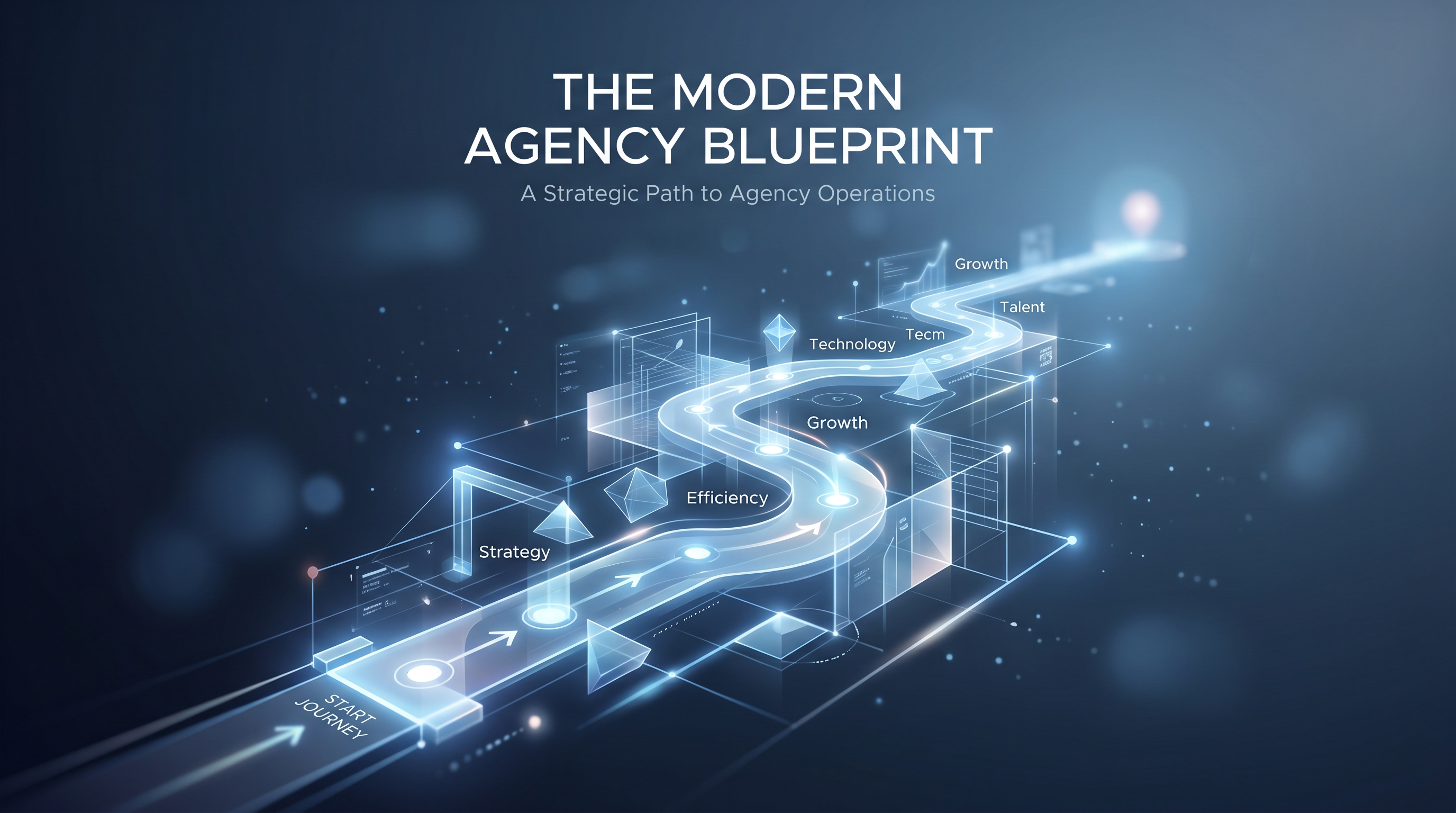
The Modern Agency Blueprint: Choosing the Most Scalable Path as a New Operator
Most new agencies die in the complexity trap before they ever land their tenth client. Here is how to avoid it.
Imagine this: You've poured your nights and weekends into learning Facebook ads, SEO tactics, and email funnels. You land your first client—a local plumber thrilled by your pitch. But as inquiries trickle in, you're suddenly drowning in custom strategy sessions, endless revisions, and midnight client calls. What started as excitement morphs into exhaustion. This isn't hyperbole; it's the stark reality of the modern agency market.
The digital marketing landscape is exploding. Businesses of all sizes crave online visibility, with global ad spend projected to surpass $700 billion annually. Yet, for aspiring entrepreneurs looking to start a digital marketing agency, the 'old way'—hustling solo with bespoke services—leads straight to burnout. You're not just selling services; you're becoming a one-person factory, juggling creative, execution, and client management. Scalability? Forget it. Without a scalable agency blueprint, you're trading time for dollars in a race you can't win.
This new agency operator guide flips the script. We'll map a path built for sustainability: niche down, systematize early, and operate like a machine from day one. Whether you're eyeing profitable agency niches or rethinking agency business models, the blueprint ahead empowers you to build without breaking.
The Complexity Trap: Why Manual Fulfillment Kills New Agencies
Picture a new operator knee-deep in the grind. Client A needs a full website overhaul. Client B demands weekly ad optimizations. Client C? Custom social media calendars tailored to their quirky brand voice. Each project feels unique, demanding your full attention. But here's the trap: manual fulfillment scales linearly at best—and usually not at all.
Complexity creeps in through fragmentation. You're splitting focus across platforms (Google Ads, Meta, email tools), compliance tweaks (privacy laws, platform updates), and client-specific tweaks. One algorithm change ripples through your entire pipeline. Revisions pile up because expectations weren't templated. Before long, your agency isn't growing—it's gasping.
New agencies crumble here because they mimic big players without the infrastructure. Veterans have teams, SOPs, and tech stacks. Beginners? Just grit. The result: 80-hour weeks, client churn from inconsistent results, and zero time for sales. Breaking free requires recognizing this as a design flaw, not a personal one.
Signs You're in the Trap
- Every client deliverable feels like a custom build, with no reuse.
- Your revenue caps at your billable hours—scaling means hiring, which means more chaos.
- Client calls dominate your calendar, leaving execution in perpetual catch-up.
- Burnout hits by month six, with no systems to delegate.
Choosing Your Pathway: Niche Selection and High-Leverage Services
Not all paths to agency success are equal. The key? Pick a lane where demand outstrips supply and fulfillment can be systematized. This is where profitable agency niches shine, and agency business models pivot from fragile to fortified.
Start narrow. Broad 'digital marketing for everyone' invites competition from giants. Instead, target industries with recurring pain points and budgets: dentists needing patient funnels, HVAC pros chasing emergency leads, lawyers building authority funnels. These aren't random; they're battle-tested for high lifetime value and low churn.
High-Leverage vs. Commodity Services
Commodity services—like one-off SEO audits or basic PPC setup—trap you in price wars. High-leverage ones? Retainer-based lead gen systems, automated funnels, and performance dashboards. They compound: one template serves dozens, with tweaks minimal.
- High-Leverage: Plug-and-play funnels for niches (e.g., 'Dental Lead Machine'). Scalable via automation.
- Commodity: Manual content creation or ad copywriting. Replaceable and non-recurring.
Your scalable agency blueprint begins here: Validate niches via tools like Google Trends or industry forums, then prototype one service. Test with three clients. If it sticks, systematize.
The Operator Mindset: From Hustler to Systems Builder
The hustler grinds deliverables, celebrating each win but dreading the next. The operator? Designs the machine that delivers while they steer. This shift is mental first: from 'doing the work' to 'ensuring the work gets done right.'
Hustlers scale to $10K months, then stall. Operators hit $50K by month 12, outsourcing fulfillment. The difference? Mindset. Operators document processes day one, hire virtual assistants for ops, and measure everything. They're playing chess while hustlers play checkers.
Operators don't replace themselves—they build systems so irreplaceable that clients stay for the results, not the person.
Cultivating the Operator Edge
- Track time weekly: If over 50% is fulfillment, systematize now.
- Adopt 'one to many': Create templates before custom work.
- Delegate ruthlessly: VAs for research, freelancers for tweaks.
Infrastructure-First Strategy: Leverage Autonomous Systems for Beginners
Building tech from scratch? That's a six-figure distraction. Agency infrastructure for beginners means plugging into proven stacks. Tools like Zapier for automations, ClickFunnels for landing pages, or Klaviyo for emails let you launch fast.
But the real accelerator? Autonomous infrastructure tailored for agencies. Platforms handling ad management, A/B testing, and compliance mean you focus on sales and strategy. No more midnight dashboards.
Enter solutions like AscendsOp, which connects new operators to autonomous agency operations. Pre-built for niches, they provide white-label fulfillment, letting you start a digital marketing agency with zero dev overhead. It's infrastructure-first: onboard clients, activate systems, collect retainers.
Profitable Pathways for 2024 and Beyond
2024 demands niches resilient to economic shifts. Focus on essentials: services businesses can't pause.
Top Profitable Agency Niches
- Dental: Patient acquisition via local SEO and Google Ads. Retainers $2K+/mo.
- HVAC/Plumbing: Emergency lead gen funnels. High urgency, fat margins.
- Legal (Personal Injury/Family): Intake forms and authority content. LTV $10K+.
- Home Services (Roofing, Pest Control): Seasonal campaigns with evergreen SEO.
- Med Spas: Booking automations for Botox and fillers.
These thrive because problems recur. Pair with autonomous tools for 80% margins. Your new agency operator guide play: Pick one, master the funnel, scale via partnerships.
Building for Autonomy: Client Intake and Reporting from Day One
Autonomy isn't an afterthought—it's the foundation. Set up intake as a self-serve portal: questionnaire, contract sig, payment link. No back-and-forth.
Reporting? Automated dashboards via Google Data Studio or agency-specific tools. Weekly emails with KPIs: leads generated, ROI tracked. Clients feel transparency; you feel freedom.
Day-One Checklist for Autonomy
- Intake: Calendly + Typeform → Zapier → Client folder.
- Fulfillment: Activate pre-built campaigns in your stack.
- Reporting: Set weekly auto-sends with agency scaling metrics.
- Escalations: 15-min ops calls only.
With AscendsOp, this is plug-and-play. Connect, customize lightly, launch. You've built a business that runs while you acquire.
Your Scalable Future Starts Now
The complexity trap claims most, but not you. Armed with this scalable agency blueprint, niche insight, and operator mindset, you're positioned for $100K months without the grind. Leverage agency infrastructure for beginners via platforms like AscendsOp to accelerate.
The market rewards operators who build systems first. Pick your niche, plug in the stack, and watch retainers stack. Your agency isn't just profitable—it's autonomous. Ready to launch?