Agency Infrastructure vs Tools: You Have the Tech Stack, But Do You Have the Operational Backbone?
You have the tools. A gleaming array of software suites—CRM platforms humming with leads, automation bots firing off emails, analytics dashboards blinking with metrics. Your autonomous agency operations look primed for scale. But do you have the infrastructure? That invisible lattice holding it all together, turning chaos into leverage?
In the high-stakes world of digital marketing agencies, solopreneurs chase the next shiny tool like it's the holy grail. Yet, amid the notifications and logins, a quiet crisis brews: operational overwhelm. Tools promise freedom, but without agency infrastructure, they become shackles. This isn't about ditching your tech stack; it's about forging the operational infrastructure that makes it sing.
Welcome to Infrastructure Education, where we dissect autonomous systems vs tools. We'll uncover why your agency tech stack vs infrastructure debate is the linchpin of scalable growth—and how platforms like AscendOp bridge the gap, connecting operators to ready-made ecosystems.
The Myth of the Perfect Tech Stack: Tools Alone Won't Scale Your Agency
Picture this: It's 2 a.m., and you're knee-deep in a client crisis. Your project management tool pings with overdue tasks, your email automation glitches on a nurture sequence, and your reporting dashboard shows traffic dips you can't explain. You've invested thousands in the best modern agency backend tools—ClickUp for tasks, Klaviyo for emails, Google Analytics for insights. Yet, you're exhausted, reactive, and no closer to that six-figure retainer dream.
This is the tool trap. Agencies load up on software, mistaking accumulation for progress. A typical operator juggles 10-15 apps, each solving a sliver of the puzzle. But integration? Customization? That's on you. The result: fragmented workflows, data silos, and constant context-switching that devours hours.
Tech Stack vs Operational Backbone: The Core Difference
Agency tech stack refers to the discrete tools you deploy: Zapier for automations, Asana for collaboration, HubSpot for CRM. They're the hammers, saws, and drills in your digital toolbox. Powerful, yes—but inert without a blueprint.
Agency infrastructure, or backend operational systems, is the workshop itself: the assembly line, conveyor belts, and quality controls that orchestrate tools into seamless flow. It's the predefined pathways ensuring a lead from Facebook Ads flows effortlessly to fulfillment, delivery, and reporting—without your fingerprints every step.
Tools execute tasks. Infrastructure executes business.
In essence, agency tech stack vs infrastructure boils down to reactive vs proactive. Tools react to your inputs; infrastructure anticipates outcomes, embedding leverage into every process.
Why Most Agencies Lack Operational Infrastructure—and Suffer For It
Solopreneurs and consultants thrive on hustle, but scaling demands systems. Without operational infrastructure, even autonomous setups falter. Here's the breakdown:
- Fragmentation Frenzy: Tools don't talk natively. You Zapier-zap from one to another, but one API tweak breaks the chain. Result: manual firefighting.
- Scalability Ceiling: A solo operator handles 5 clients with tools alone. At 20? Overwhelm hits. Infrastructure scales linearly—or exponentially.
- Knowledge Bottlenecks: Your brain is the glue. Team hires or vacations expose the fragility.
- Compliance and Quality Gaps: No standardized reporting means inconsistent client deliverables, eroding trust.
Data paints the picture starkly: Agencies without robust backend operational systems report 40% higher churn from operational errors. The fix? Shift to operational leverage systems that amplify human effort.
The Hidden Cost of Tool Overload in Your Modern Agency Backend
Ever mapped your weekly hours? 60% on ops, 20% on strategy, 20% billable? That's the toll. Tools multiply tasks if un-orchestrated—checking inboxes, reconciling data, chasing approvals. Autonomous systems vs tools flips this: Systems run autonomously, freeing you for high-leverage work like client acquisition.
Building Your Agency Infrastructure: From Chaos to Autonomous Fulfillment
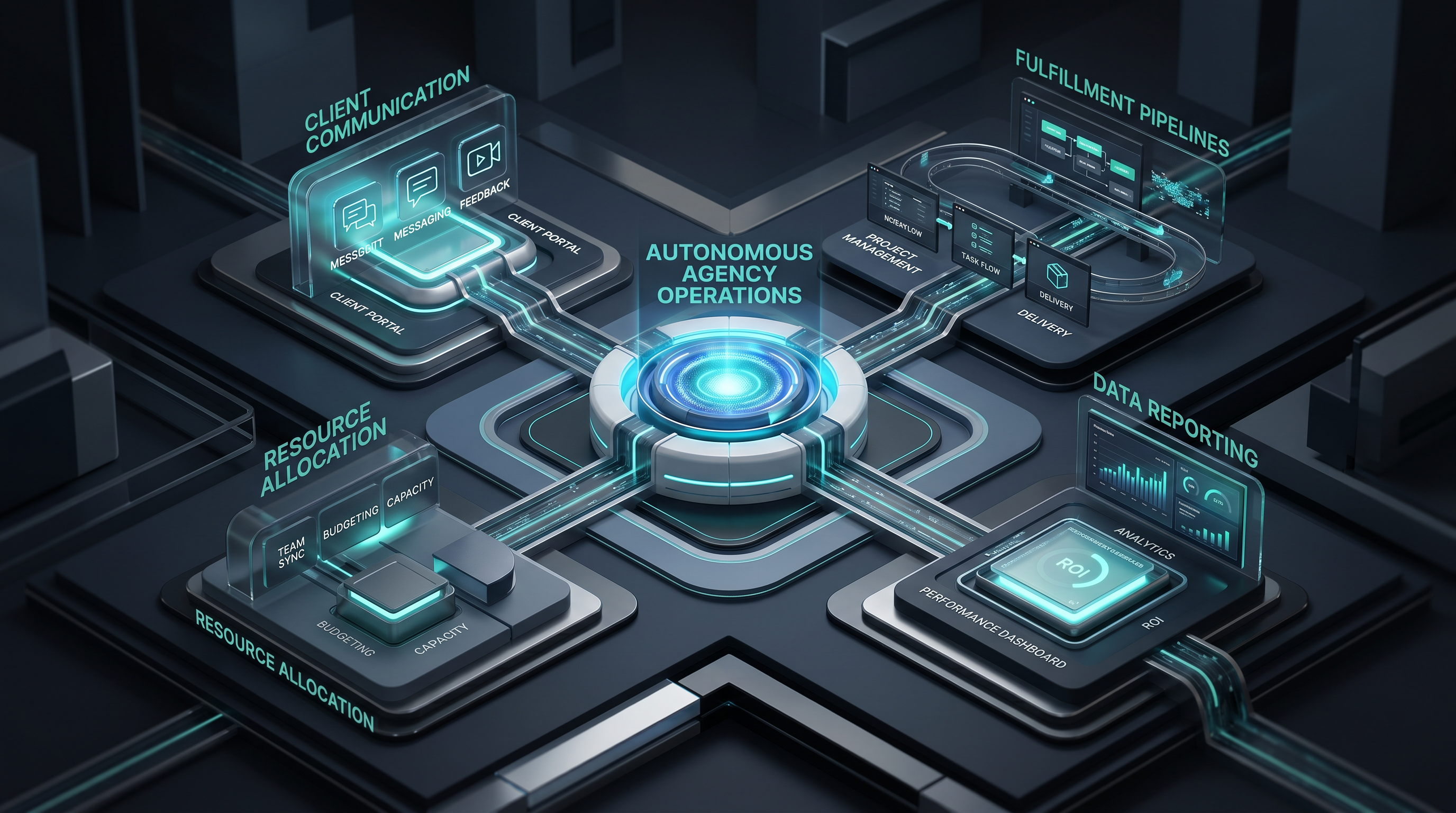
Agency infrastructure isn't built overnight; it's layered strategically. Start with core pillars: fulfillment, communication, reporting. Each becomes autonomous when infrastructured.
Autonomous Fulfillment: Delivering Without the Drama
Fulfillment is the engine. Tools like Trello track tasks; infrastructure automates the lifecycle. Imagine a new SEO client onboarding: Lead hits CRM → Auto-provisions Google Workspace → Triggers content calendar in Notion → Assigns writer via integrated Slack bot → Progress tracked in shared dashboard. No emails, no chases.
Concrete example: A PPC campaign setup. Infrastructure routes ad copy approval through Typeform → Deploys via Google Ads API → Monitors spend with custom alerts → Auto-pauses underperformers. Fulfillment becomes hands-off, scaling to dozens of clients.
Seamless Communication: No More Inbox Black Holes
Communication crumbles agencies. Tools like Slack notify; infrastructure contextualizes. Build pipelines where client queries auto-categorize (urgent/maintenance/new biz), route to specialists, and log resolutions back to CRM—complete with timestamps and attachments.
Picture a retainer update: Infrastructure pulls performance data, formats a branded PDF via PandaDoc, schedules via Calendly, and follows up with Loom video. Clients feel VIP; you reclaim hours.
Reporting That Drives Retainers: Automated Insights
Reporting is retention gold. Tools aggregate data; infrastructure narrates it. Set up modern agency backend flows: GA4 + Looker Studio → Custom dashboards → Scheduled via Make.com → Personalized via Airtable merges → Delivered via Front email.
Advanced: AI summaries via OpenAI API highlight wins, flag risks. Clients get weekly insights; you get upsell ammo—all autonomous.
Operational Leverage Systems: The Multiplier Effect
Operational leverage systems turn infrastructure into rocket fuel. Leverage compounds: One-time setup yields recurring output. Key principles:
- Modularity: Plug-and-play modules for services (SEO, PPC, content).
- Zero-Touch Triggers: Events (new lead, milestone hit) spawn actions without intervention.
- Feedback Loops: Systems self-optimize—low engagement? Auto-nudge campaigns.
- Role-Based Access: VA logs in, sees only their slice; full transparency without overload.
Outcome? A solopreneur oversees 50 retainers with a part-time VA. Leverage = 10x capacity without 10x headcount.
Reducing Complexity: The Path to True Autonomy
Complexity kills. Infrastructure prunes it: Consolidate to 5-7 core tools, wired via hubs like Make or n8n. Standardize templates, SOPs embedded in tools. Result: Onboard a VA in hours, not weeks.
AscendOp embodies this. We connect operators to pre-built agency infrastructure ecosystems—autonomous fulfillment pipelines, comms hubs, reporting engines—tailored for digital marketing. No coding marathons; just plug in and scale.
AscendOp: Your Bridge to Backend Operational Systems
Building from scratch? Daunting. AscendOp streamlines it. Our platform delivers turnkey operational infrastructure: Drag-and-drop autonomous systems that unify your tech stack. From lead-to-deliver flows to AI-powered reporting, we handle the wiring so you focus on growth.
Operators report 70% time savings post-integration. It's not just tools—it's the backbone for modern agency backend dominance.
- Pre-configured for SEO, PPC, social.
- Scales from solo to 50+ clients.
- White-label ready for consultants.
The Infrastructure Imperative: Scale or Stagnate
You've mastered tools. Now claim your agency infrastructure. Ditch the overwhelm; embrace autonomous systems vs tools wisdom. Build—or connect to—operational leverage systems that propel you forward.
The agencies winning today aren't tool hoarders; they're infrastructure architects. Your tech stack awaits its backbone. Ready to connect?
AscendOp makes it effortless. Step into the future of scalable ops—where tools serve you, not the reverse.