Running a dental practice? Get done-for-you growth at TranscendOps →
Dental Operational
Infrastructure
Every new patient call that goes to voicemail is revenue walking to another practice. Front desk overload, appointment leakage, and treatment plan follow up gaps silently erode your production numbers. Infrastructure driven systems capture and convert while your clinical team stays focused on care.
The Operational Reality
Dental practices often lose their most valuable new patients during the first five minutes of contact.
In a modern dental practice, the front desk is often the greatest operational bottleneck. When new patient calls go to voicemail because the team is busy with a checkout or a procedure, that conversion opportunity is frequently lost. Patients searching for a new dentist will rarely leave a message; they will simply call the next practice on the list.
Beyond the initial contact, the management of the appointment pipeline and treatment plan follow up is often inconsistent. Relying on manual phone calls for appointment confirmations or recall sequences creates administrative drag that prevents the practice from scaling. The reputation of the practice depends on a consistency that manual systems simply cannot provide.
The problem isn't your front office team; it is the lack of connected infrastructure. Until your patient intake and communication systems are separated from the hours of your staff, your growth will be limited by the capacity of your team to handle tasks. Modern operators connect into infrastructure that standardizes the patient experience.
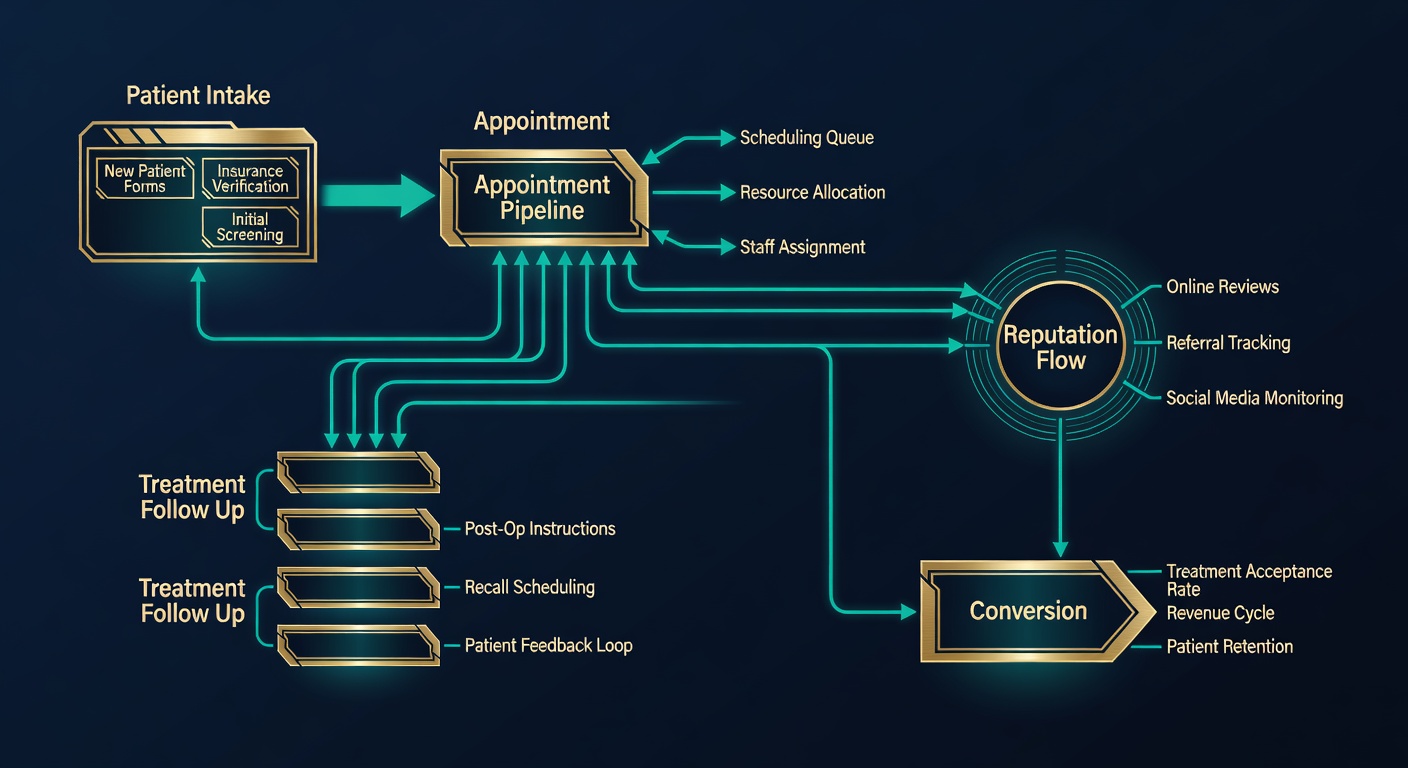
Infrastructure Driven Pipeline
What Infrastructure Changes
Moving from administrative chaos to systematic patient conversion and retention.
Connecting into infrastructure changes how your dental practice interacts with the market. Patient intake becomes an instant, autonomous process. New patient inquiries are qualified and scheduled the moment they arrive, ensuring that your practice is always the first to respond.
This infrastructure handles the backend communication required to move patients through the treatment plan. Follow up sequences are automated, ensuring that no patient is forgotten after their initial consultation. This level of consistency builds long term value and stabilizes the practice's revenue.
The ecosystem provides the frontend communication systems required to maintain a professional presence without increasing administrative hours. The operator gains access to infrastructure that manages the patient lifecycle, allowing the clinical team to focus entirely on patient care.

Front desk teams supported by infrastructure create a practice that never misses a patient.
The Real Cost of Manual Operations
Operational bottlenecks are not just inconveniences — they are economics problems. Every delay, every missed lead, and every manual process has a measurable cost.
Intake Leakage Cost
A dental practice losing just two new patient calls per day to voicemail or delayed response is losing approximately 40 to 50 new patients per month. At an average first year patient value of $800 to $1,200, that represents $32,000 to $60,000 in annual lost production.
Front Desk Overload
When your front desk team is simultaneously checking in patients, answering calls, and managing insurance verifications, something breaks — usually new patient intake. Infrastructure offloads the repetitive intake tasks so your team can focus on the in office patient experience.
Treatment Plan Follow Up Gap
Practices that rely on manual follow up for treatment plans typically see 30 to 50 percent lower acceptance rates than those with systematic, consistent follow up cadences. Each unaccepted plan represents production value your clinical team has already identified but cannot capture.
Key Operational Insights
Four ways infrastructure changes the trajectory of a dental practice.
New Patient Response Time Determines Conversion
When a potential patient calls for an appointment, the speed and professionalism of the response is the single biggest determinant of whether they become your patient or call the next practice on their list. Infrastructure ensures that first contact happens within seconds — not when the front desk gets a free moment.
Appointment Pipeline Runs On Infrastructure
Your chairs should not sit empty because a call came in during a procedure or after hours. Autonomous systems qualify and schedule patients 24/7, keeping your production pipeline full without administrative lag or overtime costs.
Treatment Plan Follow Up Should Be Automatic
The largest source of unrealized revenue in dentistry is unaccepted treatment plans. Infrastructure handles the systematic, consistent follow up required to move patients from consultation to procedure — protecting production numbers that manual front desk workflows routinely leave on the table.
Reputation And Conversion Flow Are One System
A dental practice's reputation and its new patient conversion engine are not separate functions — they are connected. Infrastructure manages the review request cycle and the intake flow together, ensuring your online presence and your scheduling system reinforce each other.
Manual Practice vs Infrastructure Driven Ops
Comparing the administrative limits of traditional dentistry with modern autonomous systems.
Manual Operations
Infrastructure Driven Operations
Speed To Lead In Healthcare
Why immediacy is the foundation of patient trust and practice growth.
For a new patient, the decision to choose a dentist often starts with a moment of need or a sudden decision to finally handle a clinical issue. In that moment, they are looking for validation and a clear path to an appointment. If your practice doesn't provide that path immediately, they will continue their search elsewhere.
Infrastructure ensures that you never miss that moment. By connecting into autonomous patient intake systems, your practice provides an instant response that qualifies the patient's needs and moves them toward a booking. This level of responsiveness doesn't just fill your chairs; it establishes you as the modern, high value practice in your community.
Revenue Driven Marketing
Learn how infrastructure focuses on revenue outcomes rather than vanity metrics.
Metrics Comparison
See why practice growth depends on tracking the right operational data.
HVAC Solutions
Explore how infrastructure handles service based growth in other industries.
Dental Operational FAQ
Common questions about connecting dental practices to autonomous infrastructure.
Dental Operational Evolution
From patient acquisition chaos to systematic growth
Before Infrastructure
- • Missed new patient inquiries
- • Inconsistent follow up sequences
- • Manual appointment coordination
- • Fragmented practice reporting
After Infrastructure
- • Instant patient inquiry capture and response
- • Automated follow up and recall systems
- • Infrastructure backed scheduling coordination
- • Unified practice performance visibility
Based on real operational patterns observed across dental practice operators in the ecosystem