Running a law firm? Get done-for-you growth at TranscendOps →
Legal Operational
Infrastructure
Intake delay is the invisible margin killer in legal practice. Every consultation that leaks through slow response or inconsistent follow up represents billable hours you will never recover. Infrastructure driven operations ensure every qualified inquiry becomes a scheduled consultation — without adding headcount.
Solving Legal Operational Friction
Consultation Response Speed
In legal services, a potential client who does not receive a response within the first hour is statistically unlikely to ever retain your firm. Infrastructure ensures intake begins the moment an inquiry lands — capturing qualified consultations while your competitors are still checking messages.
Systematic Intake Management
Manual intake processes create a bottleneck where promising cases are lost between the initial inquiry and the scheduled consultation. Infrastructure qualifies and routes inquiries based on practice area, urgency, and capacity — ensuring no viable case slips through.
Communication Consistency
The gap between consultation and retention is where most legal practices lose revenue. Infrastructure maintains a structured, professional follow up cadence that respects the gravity of legal decisions while keeping your firm top of consideration.
Operational Responsiveness
Scaling a legal practice through paralegals and associates alone creates a cost structure that erodes partner margins. Infrastructure handles the operational layer — intake, scheduling, follow up, and communication — so your attorneys focus on billable work and case outcomes.
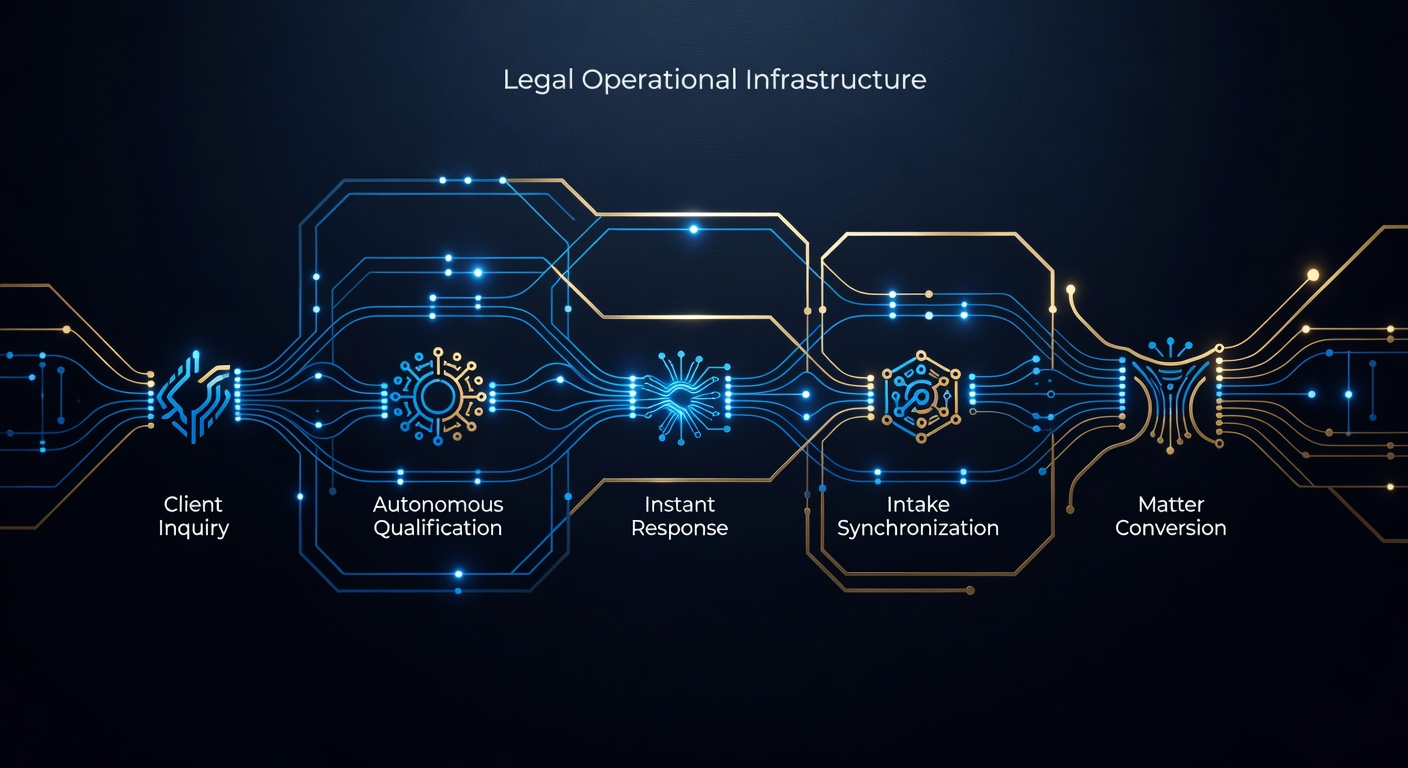
The Operational Reality
The infrastructure maintains operational consistency during the high pressure cycles of legal practice.
Consistency Under Pressure
Imagine a potential client inquiry comes in during a critical deposition. Without infrastructure, that lead sits for 6 hours. With the ecosystem, that client is qualified and scheduled before the deposition ends.
- Instant matter qualification
- Systematic intake synchronization
- Automated client follow up
- Real time status visibility
Legal practices live and die by the client experience. When intake paperwork bounces between paralegal and attorney, delays occur. When follow up on consultations falls through the cracks during case load spikes, revenue is lost. Infrastructure removes these human dependencies.
Strategic Comparison
Understand the difference between manual legal operations and infrastructure driven systems.
Manual Operations
- • Inquiries unanswered during court
- • Intake delayed by manual paperwork
- • Communication gaps during trials
- • Follow up forgotten under caseload
- • Client experience varies by availability
Infrastructure Driven
- • Instant response regardless of schedule
- • Systematic autonomous intake processing
- • Consistent communication cadence
- • Automated follow up sequences
- • Predictable, standardized client experience
Speed To Lead In Law
Why the first response is the most critical metric for legal client acquisition.

The first firm to respond wins representation. Infrastructure ensures it is always yours.
The Real Cost of Manual Operations
Operational bottlenecks are not just inconveniences — they are economics problems. Every delay, every missed lead, and every manual process has a measurable cost.
Intake Response Decay
Research consistently shows that legal inquiries contacted within 5 minutes are over 20 times more likely to convert to consultations than those contacted after 30 minutes. Every minute of intake delay is a measurable reduction in consultation pipeline value.
Consultation Leakage
Manual intake processes lose qualified inquiries between initial contact and scheduled consultation at rates that would be unacceptable in any other professional services industry. Infrastructure ensures every inquiry is tracked, followed up, and converted — systematically.
Operational Overhead Scaling
Traditional legal practice growth means adding paralegals, associates, and administrative staff — each adding $50,000 to $80,000 in annual overhead before they produce billable value. Infrastructure scales the operational layer without the proportional headcount cost.
Whether it is personal injury, criminal defense, family law, or business litigation — the first firm to respond often wins the representation. In a world of instant gratification, a six hour delay is an eternity. Infrastructure makes that speed possible without adding expensive intake staff or distracting attorneys from their work.
Strategic Modules
Autonomous operational infrastructure with human support designed for the rigorous demands of the legal industry.
Intake Infrastructure
Autonomous intake systems that ensure no matter is lost to slow response or administrative bottlenecks.
Workflow Automation
Matter specific operational sequences that improve intake efficiency and client communication.
Response Agents
Autonomous layers that qualify matters and schedule consultations instantly — 24/7 responsiveness.
Common Questions
Everything you need to know about legal operational transformation.
Related Infrastructure
Legal Operational Evolution
From intake fragmentation to operational precision
Before Infrastructure
- • Delayed client intake response
- • Manual case qualification bottlenecks
- • Inconsistent follow through on inquiries
- • Fragmented client communication
After Infrastructure
- • Immediate intake response and qualification
- • Systematic case routing to appropriate resources
- • Automated client communication sequences
- • Unified operational visibility across practice
Based on real operational patterns observed across legal operators in the ecosystem